Tag Archives: winelover

2016 Pessac-Léognan (13 wines)


Bouscaut (55% Cabernet Sauvignon, 38% Merlot, and 7% Malbec)
N: Soft, simple, and direct. Understated and good.
P: Unexpectedly light and feminine. Not in keeping with the château profile. I can only deduce that this is not the best sample, because I feel the wine is only a shadow of what it should be. Very oaky aftertaste. To try again down the line.

Carbonnieux (50% Cabernet Sauvignon, 45% Merlot, 4% Cabernet Franc, and 1% Petit Verdot)
N: Slightly medicinal. Relatively closed and not showing much fruit at this time.
P: “Fluid”, easy-going, and not over-extracted. However, too light and disappointing when the improved performance of this château’s red wine in recent years is considered.

Carmes Haut Brion (41% Cabernet Franc, 39% Merlot, and 20% Cabernet Sauvignon)
N: A certain tankiness there but, once again, that cannot be held against a wine this young, and may well dissipate. The alcohol overwhelms the berry fruit somewhat at this stage.
P: Soft and lively. Good acidity and discreet fine-grained tannin. Considerable sweetness and Graves typicity on the finish. Agreeably old-fashioned in a way. Needs time for greater balance, but promising.

Domaine de Chevalier (65% Cabernet Sauvignon, 30% Merlot, and 5% Petit Verdot)
N: Inky, serious, and enticing nose of ripe black fruit with a touch of mint.
P: Smooth and sophisticated with a vein of fresh acidity. Good fruit, resonant tannin, and a long aftertaste. Oak seems fairly strong at this stage. Very good indeed.

Fieuzal (70% Cabernet Sauvignon, 15% Merlot, 10% Cabernet Franc, and 5% Petit Verdot)
N: Rich soft-pedalled wildberry aromas.
G: Certainly refined, but on the light side and lacks stuffing. Relatively long, but not very vigorous finish.

Haut Brion: (56% Merlot, 6.5% Cabernet Franc, and 37.5% Cabernet Franc)
N: Restrained and aristocratic. My notes say: “soft, soft, and soft”.
P: This quality comes through on the palate as well, within a delicate tannic framework. Elegant to the end of its fingertips… Velvety texture and no rough edges even at this stage. Superb acidity. Will be a great beauty down the line.


Larrivet Haut Brion (62% Cabernet Sauvignon, 30% Merlot, and 8% Cabernet Franc)
N: Slightly rustic but forthright with intense berry aromas and a bit of greenness. Honest. Not messed around with.
P: Quite natural on the palate as well. Vibrant acidity with an oak kick on the finish, but this is not over the top. Good middle-of-the-road wine reminding me somewhat of La Louvière, although different, of course.

Latour Martillac (55% Cabernet Sauvignon, 33% Merlot, 8% Petit Verdot, and 4% Cabernet Franc)
N: Elegant, including the oak. Restrained and aristocratic with black cherry aromas.
P: Gorgeous ripe fruit at first and then thins out some. Typical of its appellation. Sleek and on the light side. Good medium-long aftertaste.

La Louvière (65% Cabernet Sauvignon, 30% Merlot, and 5% Petit Verdot)
N: Upfront with fine blueberry aromas. Not overoaked.
P: Plush soft berry fruit. Very Pessac-Léognan. Medium-light body. Clean mineral aftertaste with a mint/eucalyptus component. One for mid-term ageing.


Malartic Lagravière (53% Cabernet Sauvignon, 40% Merlot, 4% Cabernet Franc, and 3% Petit Verdot)
N: Ethereal and pretty cherry liqueur bouquet.
P: Round and feminine with lovely follow-through. Wonderful perky tannin with vivacious acidity. Not rich, but not light either. Despite a thirst-quenching quality, this is a serious wine with great aromatics. My notes say “vin de gastronomie” meaning it would shine especially at table with refined cuisine.
Mission Haut Brion: (57.5% Merlot and 42.5% Cabernet Sauvignon)
N: Monumental and Margaux-like with some tarry overtones. Lovely integrated oak. Incredible blackcurrant and essence of red fruits.
P: Full-bodied, even chunky, as well as quite mineral with excellent follow-through. Otherworldly aftertaste with tannin of enormous finesse. There is first class acidity to counterbalance the full body. Killer, never-ending finish…

Mission Haut Brion: (57.5% Merlot and 42.5% Cabernet Sauvignon)
N: Monumental and Margaux-like with some tarry overtones. Lovely integrated oak. Incredible blackcurrant and essence of red fruits.
P: Full-bodied, even chunky, as well as quite mineral with excellent follow-through. Otherworldly aftertaste with tannin of enormous finesse. There is first class acidity to counterbalance the full body. Killer, never-ending finish…

Olivier (50% Cabernet Sauvignon, 45% Merlot, and 5% Petit Verdot)
N: Penetrating nose with alcohol coming through more than fruit. Also a note I can only describe as acetone.
P: Chewy, a bit hollow, rough, and dry. This wine is not together and needs to be retasted to form a more accurate impression.

DSC03141
Pape Clément (50% Cabernet Sauvignon and 50% Merlot)
N: Deep, brooding dark fruit aromas just emerging. Strong but unfocused. Rhônish.
P: Round inside a framework of fruit and oak tannin. Too much oak? Time will tell. Bit dry on the aftertaste, but also mineral. Uncertain prognosis at this time.

2016 great growths: Pauillac, Saint-Estèphe, and Saint-Julien (30 wines)

Pauillac
======


Armailhac (62% Cabernet Sauvignon, 28% Merlot, 8% Cabernet Franc, and 2% Petit Verdot)
N: Sweet oak for the sweet fruit (blackcurrant and rich ripe blackberry).
P: Mouthfilling, rich, and attractive, but lacks backbone. Marked acidity on finish coats the teeth. Oak comes through too strongly, but this may just be temporary.

Batailley (85% Cabernet Sauvignon, 12% Merlot, and 3% Cabernet Franc)
N: Ripe fruit and plenty of oak, perhaps too much at this stage. Classic.
P: Round seductive attack, then dips, then returns with an aftertaste marked by acidity, tannin, and oak (especially the latter). Unexciting, but dependable.

Clerc Milon (55% Cabernet Sauvignon, 29% Merlot, 13% Cabernet Franc, 2% Petit Verdot, and 1% Carménère)
N: Lovely, powerful bouquet with decided violet nuances and some alcohol. Also blackberry and cassis nuances.
P: Round with a fine acid streak. Medium-long aftertaste. Really very good.


Croizet Bages (55% Cabernet Sauvignon, 41% Merlot, and 4% Cabernet Franc)
N: Sweet and simple, needs time to express itself.
P: Melts in the mouth. Sensual and fruit forward with sweet oak on the finish, perhaps too much at the present time. Simple structure and weak on the middle palate. Better than Croizet Bages has been in the past, but the improvement is nowhere near as patent as with the sister estate in Margaux, Rauzan-Gassies.

Grand Puy Ducasse (65% Cabernet Sauvignon and 35% Merlot)
N: Floral and grassy along with sweet red fruit, but not very concentrated.
P: Starts out deceptively soft, going on to show blackcurrant flavors and velvety tannin that converge into an aftertaste with marked teeth-coating acidity and plenty of oak – but which stops short of too much. A more commercial style for mid-term drinking.

Grand Puy Lacoste (79% Cabernet Sauvignon and 21%)
N: Slightly jammy blackcurrant with graphite nuances. Upfront, attractive, and with good oak.
P: Soft with excellant resonance. Wonderful lively acidity. Thanks to its elegance, it seems like the marriage of Margaux and Pauillac. Great finish and class.


Haut Bages Libéral (75% Cabernet Sauvignon and 25% Merlot)
N: Unmistakable Pauillac characteristics. Muted and a little jammy with hints of blackcurrant and crushed blackcurrant leaves.
P: Mouthfilling, easy-drinking wine. Chunky and spherical, but also a touch hollow on the middle palate. Simple fruit. Typical of its appellation and with the freshness of the vintage. Good value for money.

Lafite Rothschild (92% Cabernet Sauvignon, 8% Merlot)
Lovely trademark Lafite nose words cannot aptly describe. Suffice it to say that it is deep and subtle with an unmistakable violet element as well as muted graphite and coffee aromas. The wine has a gorgeous texture on the palate with the guts to back up the tremendous elegance. The aftertaste is deliciously long and aromatic. Check back in 2050! This Lafite proves that the best wines of the vintage, thanks to a streak of lively fresh acidity, have what it takes to age, as well as a unique balance between fruit, tannin, and acidity. This Lafite was one of the best wines I tasted all week. It’s nice not to be disappointed!

Latour: 2005 Château Latour (87% Cabernet Sauvignon, 12% Merlot, 0.5% Cabernet Franc, and 0.5% Petit Verdot)
This looks perhaps five years little older than its age (twelve years). The nose is redolent of luscious ripe fruit with captivating earthy nuances, accompanied by notes of pencil shavings typical of this estate as well as other Pauillacs. This graphite quality comes through on the palate as well. The taste is thirst quenching and follows through flawlessly with liquorice, blackcurrant, and wildberry flavors. There is a beautiful silky texture that leads into a majestic aftertaste with extremely fine-grained tannin and candied black fruit nuances. Last year, the 2000 Latour was poured and everyone was surprised how ready to drink it was. This 2005 is another kettle of fish. Give it another 10 years at least to make the most of it. Très grand vin.


Lynch Bages (75% Cabernet Sauvignon, 19% Merlot, 4% Cabernet Franc, and 2% Petit Verdot)
N: Fine, rich, and subtle, but largely closed now.
P: Nice mouthful of wine with rich blackcurrant flavors. Great balance between fruit, acidity, and tannin. Some roast coffee aromatics. A little alcohol on finish. Will undoubtedly age well.

Lynch Moussas (83% Cabernet Sauvignon and 17% Merlot)
N: Some reduction smells. Aromas of oak and jam and a soupçon of mint. Lacks definition.
P: Medium-heavy mouth feel but falls down somewhat after the attack. Nevertheless, an authentic Pauillac with a tangy, slightly dry finish and good oak (although this must be kept from becoming overpowering in the coming months).  Good value for money.

Château Mouton Rothschild (84% Cabernet Sauvignon, 13% Merlot, and 3% Petit Verdot)
The bouquet is undefined and obviously too young. It is nevertheless ethereal, and promising. The wine is fresh, big, and sinewy on the palate with great blackcurrant flavors. Both tannin and fresh acidity – the hallmark of the 2016 vintage – spread out over the palate, working into a long, classic aftertaste with a velvety texture and cedar overtones. Bit dry on the finish. Mouton can be uneven, but this one is a real winner. It is a virile wine, on the massive side. Revisit a few decades from now.


Pichon Baron (85% Cabernet Sauvignon and 15% Merlot)
N: Classy, brambly nose very typical of the estate with hints of fresh leather. Subdued only because very young.
P: Big with lovely tannin. Deep fruit and a certain earthiness. Refined and stately. Seems a little tough now, but just you wait! A superb Baron with tremendous ageing potential.
I usually don’t mention associated wines in these notes (2nd and 3rd wines, etc.), but 2016 Château Pibran AOC Pauillac really shone too.

Pichon Comtesse (75% Cabernet Sauvignon, 21% Merlot, and 4% Cabernet Franc)
N: Sweet, subtle lovely Médoc bouquet with sweet blueberry. Could be mistaken for a fine Margaux.
P: Perfectly round and rich on entry, going on to show great acidity (that coats the teeth), purity, restraint, and a velvety texture. Juicy, with a medium-heavy mouth feel and a great long aftertaste. A slight change in style.
I enjoy comparing Pichon Baron and Pichon Comtesse from the same vintage after a few years bottle age. The exercise with the 2016s should be absolutely fascinating because both are stellar!

Pontet Canet (60% Cabernet Sauvignon, 35% Merlot 4% Cabernet Franc, and 1% Petit Verdot)
N: Not together at this early stage, but there are spicy (cinnamon) notes to back up the incipient fruitiness.
P: Ah, the palate is more like it! The 2016 fresh acidity is there, along with a lovely, long aftertaste showing textured tannin and the estate’s pure mineral quality. Above and beyond the aforementioned freshness, the wine displays great tension and balance. Pontet Canet’s progression is confirmed.
The tasting notes don’t belong here, but Alfred Tesseron also had us taste wine from his new California estate, Pym-Rae (to be renamed Tesseron Vineyards). Located in Napa Valley’s Mount Veeder appellation that previously belonged to the late actor, Robyn Williams.

Saint-Estèphe
==========


Calon Ségur (56% Cabernet Sauvignon, 35% Merlot, 7% Cabernet Franc, and 2% Petit Verdot)
N: Fairly shut-in at this early stage, but enticing blueberry notes are starting to emerge.
P: Melts in the mouth. Appetizing. Tight-knit with lots of energy. Wonderful, fresh Médoc fruit. 100% new oak, but the wine can take it. Excellent tannin on finish. A great success. An estate going from strength to strength.
I must also mention the other vineyard they own in Saint-Estèphe (not the second wine, Marquis de Calon): Château Capbern, an absolute champion in terms of value for money!

Cos d’Estournel (76% Cabernet Sauvignon, 23% Merlot, and 1% Cabernet Franc)
N: Lovely barrel cellar bouquet along with blueberry and blackberry liqueur aromas.
P: Big volume on the palate. Soft and rich. Velvety texture and very long aftertaste. Considerable ageing potential. A toned-down modern style. Classy wine. The effect of ageing in new oak must nevertheless be followed closely.

Cos Labory (53% Cabernet Sauvignon, 44% Merlot, and 3% Petit Verdot)
N: Somewhat herbaceous, but sweet red fruit is lurking.
P: Tannin is a little tough and there is acidity in spades, but also a more modern and approachable side to this wine than in the past. The dryish finish features berry fruit and new oak.


Lafon Rochet (67% Cabernet Sauvignon, 25% Merlot, 6% Cabernet Franc, and 2% Petit Verdot)
N: A lovely mixture of graphite and black fruit with a few rustic notes.
P: Excellent mouth feel and texture. Sweet fruit and smoothness one has come to expect from this estate. Refined and has a bright future ahead of it.

Montrose (68% Cabernet Sauvignon, 25% Merlot, and 7% Cabernet Franc)
N: Gravitas. Deep and nuanced. Leather, butter, and vanilla accompany the blackcurrant aromas.
P: Quite imposing. Melts in the mouth and coats the palate. Concentrated. Fills out well and seems an ideal marriage between old and new styles. Blackcurrant galore with a suggestion of mint/eucalyptus. Impressive long aftertaste with a mineral aspect. Montrose is on a roll…

Saint Julien
========


Beychevelle (47% Cabernet Sauvignon, 47% Merlot, 5% Petit Verdot, and 1% Cabernet Franc)
N: Lovely fresh nose of candied blackcurrant and crushed blackcurrant leaves along with mineral nuances.
P: Great Médoc berry fruit that develops beautifully on the palate. Round, well-focused, and classic with an attractive tartness and mineralty. There was a time when Beychevelle was ho-hum. Not any more, and it clearly punches above its classification. I just hope the oak integrates – as I think it will – to alleviate the slight dryness on the finish. Fine potential.
I visited Beychevelle’s new cellar afterward. This is as “state-of-the-art” as anywhere in the world and was built with esthetics in mind. There is plate glass everywhere with a beautiful view over Saint-Julien’s gravelly rises. Definitely worth a visit.


Branaire Ducru (64% Cabernet Sauvignon, 27% Merlot, 6% Petit Verdot, and 3% Cabernet Franc)
N: Classic sweet fruit with some chocolate and pencil shaving notes. A touch biscuity.
P: The balance on the nose is there on the palate as well, with rich, sleek tannin. Broad-based with attractive fruit and nice grip on the finish. As good as ever.

Gruaud Larose (61% Cabernet Sauvignon, 29% Merlot, 7% Cabernet Franc, and 3% Petit Verdot)
N: Blackberry liqueur and oak. A little musky.
P: Rich, compact, and refreshing although a tad weak on the middle palate. Cleary needs to digest the oak, but there is a good solid base of ripe fruit there waiting to emerge.


Lagrange (70% Cabernet Sauvignon, 24% Merlot, and 6% Petit Verdot)
N: Enticing, fresh, primary, and rich, with coffee and ethereal red and black fruit brandy aromas.
G: Soft, mouth-coating tannin for this sturdy wine with unmistakable Médoc fruit and a fairly long aftertaste that is a little dry at this point. A good effort from this reliable estate.

Langoa Barton (55% Cabernet Sauvignon, 37% Merlot, and 8% Cabernet Franc)
N: Somewhat subdued, but the trademark blackcurrant and graphite are just waiting to come through.
P: Fresh and focused with fine-grained tannin. Lively, easy-going, “fluid”, and will be enjoyable young or old. Good oak. Well-made. A pleasure.

Léoville Barton (86% Cabernet Sauvignon and 14% Merlot)
N: Fruity, but lacks spark at this early stage.
P: Gorgeous velvety texture. Utter class. Seamless development. Top-quality tannin. Fruit needs to come through, but all the right signs are there. Very long aftertaste. Perhaps beats Léoville Poyferré by a nose.


Léoville Las Cases (75% Cabernet Sauvignon, 14% Merlot, and 11% Cabernet Franc)
N: Deep, dark blackberry and cassis fruit one would expect from Las Cases.
G: A big mouthful of wine with tons of fruit, mostly cherry at this stage. The volume and intensity are not overbearing and the wine is, as usual, in classic mode. Balance and terroir are the bywords here, because you would instinctively guess that stretch of land between Saint-Julien and Pauillac if tasted blind. An unquestionably fine vintage from this much-respected “super-second” growth.

Léoville Poyferré (60% Cabernet Sauvignon, 33% Merlot, 5% Petit Verdot, and 2% Cabernet Franc)
N: Trademark bouquet of blackcurrant fruit along with fresh forest floor aroma and graphite. Oak is not obtrusive (neither is it on the palate).
P: Smooth, sensual mouth feel and lots of deep fruit working its way into a classic finish.  Seems almost syrupy at one point and then segues into minerality. Both big and refined.  More fruit forward and a touch less serious than Las Cases, but a great wine.

Saint Pierre (73% Cabernet Sauvignon, 21% Merlot, and 6% Cabernet Franc)
N: Open, sexy bouquet of violet, cassis, blueberry cedar, and graphite.
P: Round and melts in the mouth.  Maybe a little simplistic, but in keeping with the château’s fruity crowd-pleasing style. Will be delicious early on. Tangy finish that is a little dry now.

DSC03120
Talbot (55% Cabernet Sauvignon, 39% Merlot, and 6% Petit Verdot)
N: Very refined, subtle nose. Not a hair out of place. Subtle with some roast coffee overtones.
P: Big and chunky. A meaty textbook Cab. Mouthfilling. The aftertaste defines fine Médoc. Excellent quality tannin and good acidity for a long life.

2016 Château Latour

Château Latour stopped selling on a futures basis beginning with the 2012 vintage. They nevertheless invite professionals to taste the new vintage every year just like all the other châteaux. In addition, they pour older wines that have been released on the market on this occasion.

DSC03069

2016 Pauillac (54.6% Cabernet Sauvignon, 38.9% Merlot, and 6.5% Petit Verdot): I must admit to once again being very taken with the Latour’s third wine. Even if rather subdued at present, it shows ripe, sweet, plummy, blackurrant preserves on the nose and reflects its terroir – a sort of apotheosis of Cabernet Sauvignon, even at this level and despite the much lower percentage of that variety in the final blend compared to the grand vin. It may be a tad weak on the middle palate and does not have quite the breadth of the latter, but is a very good wine.

2016 Les Forts de Latour (64.3% Cabernet Sauvignon, 35.3% Merlot, 0.4% Cabernet Franc)
This is unsurprisingly one step up from the Pauillac AOC. It has a nice, fresh, promising nose with a slight, not unpleasant herbaceousness, as well as a meaty quality. The wine is big and spherical on the palate and spreads out with considerable richness. Les Forts displays the 2016 sweetness along with decent grip, great acidity, and a dry mineral aftertaste. The finish is layered and velvety.

2016 Château Latour (92.9% Cabernet Sauvigon, 7.1% Merlot) – The bouquet is at the same time seductive and aristocratic, with violet overtones. Divine.
To say the least, the wine has good structure on the palate. Very much the “iron fist in a velvet glove”. Big and develops with self-assurance and grace. The tannins coat the teeth and the aftertaste goes on and on. If this is a monster, it is a very well-behaved one… Superb potential.

The three 2016s were followed by same three wines from older vintages that are in bottle and out on the market:

2012 Pauillac (43.9% Cabernet Sauvignon, 54.5% Merlot, and 1.6% Petit Verdot)
This wine looks older than its years and the rim is just starting to brown.
It already has a nose of lovely aged claret with a trace of cocoa. There is also a definite greenness, the effect of a late-ripening year, but it fits in somehow. The wine is somewhat thin and angular on the palate, but the Latour style is definitely there. Austere. A Bordeaux for Bordeaux lovers. Others might be put off. Relatively long aftertaste, once again mineral.

2011 Les Forts de Latour (61.5% Cabernet Sauvignon, 35%% Merlot, 0.5% Cabernet Franc, and 3% Petit Verdot)
Very deep youthful color with an uplifting bouquet of red fruit, menthol, and graphite. Already quite expressive at this age. The wine starts off round and attractive on the palate, then dips somewhat before coming back with a deep mineral aftertaste. There is a slightly dilute quality to the wine, but this is redeemed by the forceful aftertaste, which is very dry. Not the greatest balance, but bears the unmistakable stamp of Latour’s terroir.

2005 Château Latour (87% Cabernet Sauvignon, 12% Merlot, 0.5% Cabernet Franc, and 0.5% Petit Verdot)
This looks perhaps five years little older than its age (twelve years). The nose is redolent of luscious ripe fruit with captivating earthy nuances, accompanied by notes of pencil shavings typical of this estate as well as other Pauillacs. This graphite quality comes through on the palate as well. The taste is thirst quenching and follows through flawlessly with liquorice, blackcurrant, and wildberry flavors. There is a beautiful silky texture that leads into a majestic aftertaste with extremely fine-grained tannin and candied black fruit nuances. Last year, the 2000 Latour was poured and everyone was surprised how ready to drink it was. This 2005 is another kettle of fish. Give it another 10 years at least to make the most of it. Très grand vin.

Bordeaux Carménère – a resuscitated grape variety

DSC03056


Carménère is a sort of mystery variety in Bordeaux. It is a member of the Cabernet family and at one time was widely planted in the Médoc, then all but disappeared after the phylloxera crisis.  The name comes from the French word “carmin”, meaning “crimson”. You can find various spellings, with accents going every which way or removed altogether, but it is indeed Carménère.

In 1994, there were just 10 hectares of Carménère in all of France. But that changed with the trend to stand out by making more complicated blends in Bordeaux, incorporating Petit Verdot, Sauvignon Gris, etc. That having been said, total plantings are still very small and varietal Carménère wines in Bordeaux are still like hen’s teeth.

Interestingly, the variety is widely grown in Chile, propagated from 19th century cuttings brought from France. There are now 9,000 hecares under vine there.

I bought my cuvée Carménère, AOC Bordeaux Supérieur from Château Recougne at the extraordinary boutique at the Maison de la Quality (Planète Bordeaux), home of the Syndicat des Bordeaux et Bordeaux Supérieur in Beychac-et-Cailhau.

The château belongs to the Milhade family, who also own Château Lyonnat in Lussac Saint-Emilion and Château Boutisse in Saint-Emilion. The name Recougne comes from “terra recognita”, meaning “terres reconnues”, which can be loosely translated by “land recognized (as being good)”.
Recougne is a huge estate (90 hectares) in Galgon, near Fronsac and just 5 km from Pomerol. Their Carménère represents only a tiny part of total production.

2012 is not the greatest vintage in Bordeaux, and I did not know what to expect from this Carménère. But I was pleasantly surprised. The thing that sets the wine most apart from other Bordeaux is its bouquet, with spicy and peppery overtones. The wine was also well-balanced and very drinkable, with dark fruit and liquorice nuances. This is an inexpensive fun wine, not only rare, but worthwhile and a great one to serve blind…


Overview of the 2016 vintage from the Institute of Vine and Wine Sciences (University of Bordeaux)

As we go into en primeur week, this is the first “official” look at the 2016 vintage now that the wines have begun to age:

Professor Laurence GENY and Doctor Axel MARCHAL
Institute of Vine and Wine Sciences of Bordeaux University, Oenological
in conjunction

V. LAVIGNE-CRUEGE*, E. GUITTARD*, N. DANEDE*, C. BAZ*, L. RIQUIER*, A. BARSACQ* and Ph. PIERI**

*Institute of Vine and Wine Sciences of Bordeaux
University, Oenological Research Unit

** Institute of Vine and Wine Sciences of Bordeaux
University, UMR 1789 Functional Ecophysiology and Genomics of the Vine, INRA (the French National Institute of Agricultural Research)

 It is always somewhat risky to announce a second great vintage in a row without appearing unduly optimistic. However, 2016 is unquestionably remarkable in Bordeaux, combining quality, quantity, and a very classic

Before looking into the effect of weather conditions on vine physiology and grape composition, let us once again consider the main parameters of a quality vintage in Bordeaux. A successful red wine vintage depends on five essential conditions:

(1) and (2) – Relatively quick flowering and fruit-set during weather that is sufficiently warm and dry to ensure good pollination and predispose towards even ripening,

(3) The gradual onset of water stress thanks to a warm, dry month of July in order to slow down and then put a definitive stop to vine growth no later than the beginning of véraison (colour change),

(4) Full ripening of the various grape varieties thanks to dry and warm (but not excessively so) weather in the months of August and September,

(5) Fine (relatively dry and medium-warm) weather during the harvest making it possible to pick the grapes in each plot at optimum ripeness without running the risk of dilution, rot, or loss of fruity aromas.

An incredibly wet spring was quite worrying for winegrowers at the time (danger of fungal diseases), but later proved to be a godsend. The soil’s water reserves were largely reconstituted, enabling the vines to cope with the exceptionally dry, hot summer. The grapes finished ripening during beautiful, relatively warm weather, with very little rain and cool nights. This unhoped for, simply incredible weather for Bordeaux made it possible to harvest deeply-coloured, aromatic grapes with beautiful acidity.

The best white wine terroirs in Bordeaux (limestone, clay-limestone, and clay-gravel soils) protected the vines from premature or overly severe water stress. Sauvignon Blanc grapes retained surprising aromatic freshness and acidity on these types of soils. The Sémillon grapes were also very successful: plump and tender.

The dry, hot summer of 2016 was also conducive to the perfect maturity of grapes in Sauternes and Barsac prior to the development of botrytis. This is a vital prerequisite for the quality of sweet white wines. Two short, but significant rainy periods triggered the development of noble rot starting in mid-September. This was followed by a return to an anticyclone propitious to concentrating the grapes. Very spread out in 2016, the harvest began in the latter half of September and finished in early November.

A mild and extremely wet winter, followed by a gloomy spring, caused a delay in vegetative growth.

 Although 2015 ended on a particularly dry, sunny note, the first three months of 2016 had above-average rainfall with accumulated precipitation close to 500 mm compared to the 30-year average of 230 mm.

Despite this grey, wet weather, temperatures were mild. In fact, the winter of 2016 was the most clement since statistics have been kept. No daytime sub-zero temperatures were recorded and there was frost on just five days.

That is why the first signs of vegetative growth (swelling buds) that appeared in late February gave the discomforting impression of extreme precociousness. However, temperatures dropped to the seasonal average starting on the 20th of February and even less in the second ten-day period of March.

Cold temperatures in March and waterlogged soils due to heavy precipitation in the early part of the year delayed bud break, which began the last week in March, one week later than usual, but earlier than 2010, 2012, 2013, and 2015 (and later than 2011 and 2014).

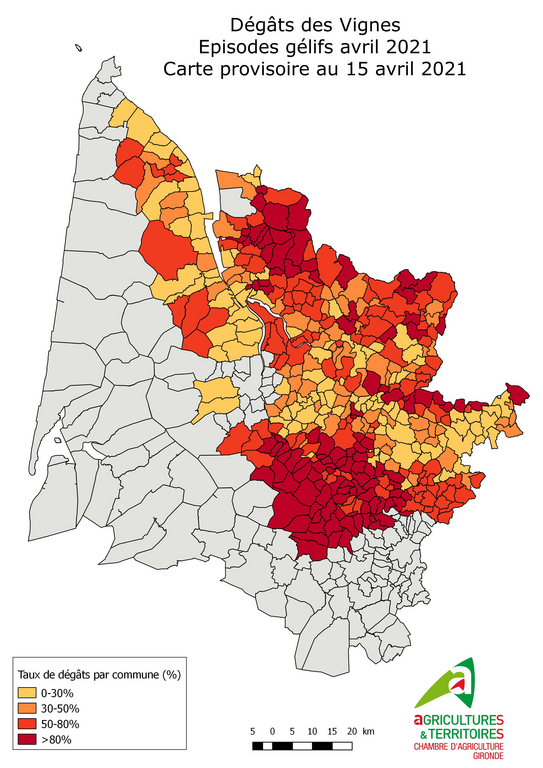
Cool temperatures beginning in late February lasted until May. As often happens at that time of year, there were alternating warm and cold periods, with a large diurnal temperature difference that did not facilitate regular vine growth. Despite the rather early bud break, the weather until late May delayed vine growth. Phenological development was also slower than usual. This situation was compounded in some regions by frost on the last three days of April that caused major damage in localised areas.

This meant that, by late May, precocious vegetative growth was no longer the case and phenological maturity was comparable to 2014.

A providential window of fine, dry weather at the beginning of flowering limited coulure

After a gloomy winter and rainy spring, there was some apprehension about flowering. Depending on the type of soil and its water retention capacity, some vines showed normal development, whereas others with a skimpy leaf canopy or on cold clay soil were behind. That explains why coulure (as in 2013) was feared.

Flowering began during rainy weather in the last days of May. However, there was a providential window of dry, warm weather between the 3rd and the 11th of June. Mid-flowering in our reference vineyards took place around the 11th of June, i.e. 8 days later than the 20-year average (Table II). The change in the weather fortunately avoided widespread coulure. The end of flowering in certain late-ripening plots was slightly perturbed by a a final rainy period that caused some millerandage.

Fruit set occurred 8 days later. Bunches were relatively homogeneous and the number of seeds greater than average – the sign of good pollination.

After three days of rain in mid-June, beautiful weather finally set in and proceeded to lasted for quite some time. This definitively changed the nature of the vintage. High temperatures in the last ten days of June enhanced berry development. These grew very quickly, and became “pea size” by the end of the month.

At this stage, the first two prerequisites for a good vintage, i.e. quick even flowering and fruit set, were fulfilled in most plots. Overall maturity was uniform with little coulure.

An exceptionally hot, dry summer leading to lasting water stress

The remarkably fine weather in late June continued into July and August.

A few very hot days around the 15th of June degraded the herbaceous aromas without bringing growth to a halt. Rainfall was infrequent and light, while temperatures were normal and there was slightly more sunshine than usual. (Table I). Due to heavy winter rains, the lack of water stress during vegetative growth accounts for the rather large size of the berries. Bunch closure took place about the 20th of July, as in 2011 and 2015.

The water balance in late July was not conducive to stopping vegetative growth definitively (figure 6) or triggering véraison in a significant way, except on clay-gravel soils. The grapes first began to change colour in the last days of July on terroirs prone to early ripening. However, seeing as vegetative growth had not completely stopped, véraison got off to a slow start. It took until the first week of August for colour change to become noticeably widespread.

Water stress was accentuated by the absence of rain. The situation was comparable to 2010 midway through véraison. These conditions were conducive to good structure in the cell walls and the accumulation of phenolic compounds, as well as facilitating the end of véraison.

A halt to vegetative growth, the 3rd condition for a great red wine vintage, was attained by mid-véraison. Although this occurred slightly later than hoped, colour change was complete enough for a perfect start to ripening.

The month of August featured real summer weather.  It was very hot (5°C more than usual) with a remarkable amount of sunshine (+30% compared to an average year). Fortunately, minimum night-time temperatures were close to the thirty-year average, and even less on some nights. This large diurnal temperature difference guaranteed the potential formation of anthocyanins, while limiting the degradation of aromas and acids in the grapes. The absence of major precipitation caused excessive water stress in some locations, especially in plots of young vines, ones with high yields, and ones with shallow soil.

Much-welcomed showers in early September gave a new boost to ripening

In late August, a few instances of scorching were noticed in vines that had undergone excessive leaf thinning and everyone began to wonder about the danger of inhibited ripening. A heat wave arrived in early September, with average temperatures of 30-32°C. The first 13 days of September were the hottest since 1950, reaching a record 37°C in Sauternes on the 12th of September.

A storm arrived from the Basque Country late in the afternoon of the 13th of September. It rained throughout Bordeaux the following night, with varying intensity depending on the region. A depression lasting three days brought as much as 40 cm of rain in some parts of Bordeaux.

However, the sun returned on the 20th of September and, with it, fine weather that lasted until the end of the harvest.

This rainy period gave a new impetus to ripening. Cabernet Sauvignon and late-ripening Merlot grapes benefited particularly from this.

A sunny mid-September and month of October virtually without any rain completed ripening and made for a leisurely harvest

Once again, the month of September was decisive for the quality of the vintage. October was dry and sunny, with cool nights making it possible to wait serenely for the best time to pick all grape varieties.

The rain in early September gave a boost to maturity, which nevertheless took more time than usual to be reached. The sunshine and relatively cool night-time temperatures were conducive to the unusually large accumulation of phenolic compounds, as well as the preservation of aromas and acidity.

These weather conditions stopped grey rot from developing, except in certain parts of Bordeaux where fairly heavy rain in early September forced winegrowers to pick early.

The rain in early September, followed by a dry, but not excessively hot period, ensured that ripening would start up again – the fourth condition for a great red wine vintage. The month of October was just as sunny, but cooler, enabling the Cabernets to ripen fully. 

Despite the heat in June and July, the 2016 vintage was not particularly early.

The dry white wine harvest began in the Graves and Pessac-Léognan appellations at the very beginning of September, about one week later than in 2015. After a remarkably dry month of August, the grapes were in perfect condition, without a trace of grey rot. Although they quickly attained sufficient sugar levels, their potential fruitiness, which had stayed in the background for a long time, also came to the fore at the end of ripening. The showers in mid-September did not have a major effect on the grapes, which could be picked without any need to hurry. Yields were very satisfactory, especially for Sauvignon Blanc, where such prolific production had not been seen in years.

The freshly-picked grapes had lower sugar levels than in 2015, but in keeping with the previous 5-year average. Total acidity was slightly lower than in 2013, 2014, and 2015, and similar to 2011 (Table IV). The balance between sugar and acidity gave rise to hopes that 2016 would be a good vintage for white wines, especially those from soils where they are traditionally successful (limestone, clay-limestone, and clay-gravel) and which are conducive to retaining good acidity.

The red wine harvest began with the most early-maturing plots of Merlot in the third week of September, but most grapes were picked in early October, i.e. one week later than usual. Harvesting of the Cabernets and Petit Verdot went on until just after mid-October during sunny weather.

Therefore, the fifth and final prerequisite for a good red wine vintage – fine weather during the harvest – was perfectly fulfilled in 2016.

Ideal conditions for harvesting excellent quality grapes

The red wine grapes in 2016 were characterized by a reasonable degree of potential alcohol and an outstanding phenolic composition.

As opposed to other French regions adversely affected by violent weather, the vintage in Bordeaux was generous. This can be explained by the large number of grapes per cluster as well as their size.  Because water stress manifested itself rather late, the berries were comparable in weight to 2015, but lighter than in 2010. The very low malic acid content – the lowest since 2009, except for 2011 – was due to the hot, dry summer weather.

These meteorological conditions enhanced the degradation of isobutyl-methoxypyrazine. This compound, responsible for “green pepper” aromas in Cabernet, was practically unable to be detected from the very beginning of the ripening.

Alternating cool nights and sunny days in September was conducive to the remarkable accumulation of anthocyanins. Content was higher than in 2015 or 2009, and close to 2011. Extraction took place slowly and varied according to grape variety. Extractability was greater for the Cabernets than for Merlot – proof of excellent maturity in the later-ripening varieties. Colour was deep and the tannin in the seeds was most often ripe and of high quality in 2016.

Due to the lack of rainfall until mid-September, botrytis took its time to appear and so grapes in Sauternes and Barsac were essentially concentrated at first thanks to raisining. However, showers on the 13th and 30th of September triggered the development of noble rot on perfectly ripe grapes, and their concentration was enhanced by the return of fine weather. Picking during the second trie, or pass, constituted the lion’s share of the best part of the harvest, which lasted until early November. The quantity of wine made at several estates reached a record high.

 Good dry white and sweet white wines, and outstanding red ones

The 2016 dry white wines are good. They are fruity and flavoursome, less acidic than the three previous vintages, and well-balanced. The Sémillon wines were especially successful in 2016, adding body and softness to the blend, but without heaviness.

The great wines of Sauternes and Barsac are extremely pure. Very rich and showing candied fruit overtones, they display a style that emphasises power rather than bright aromatics or freshness.

At the beginning of ageing, the 2016 red wines give every indication of being outstanding. They have an amazing colour. They are also fruity, without any herbaceousness, and combine the tannic power of great vintages with a deliciously velvety texture. Their relatively high level of acidity gives them an admirable freshness and tremendous balance, without any hardness. The vintage is unprecedented, more classic than 2009 or 2015, and seems to have very long ageing potential.


Book review: “From Yquem to Fargues” by Alexandre de Lur Saluces

20170217_165129_001[1]

At the age of 82, Alexandre de Lur Saluces has written a book telling us of his trials, tribulations, and joys in the many years he has made world class wine in Sauternes.

d’Yquem à Fargues – l’excellence d’un vin, l’histoire d’une famille” was published by Gallimard in November 2016.
https://www.amazon.co.uk/s/ref=nb_sb_noss/253-1422515-3899335?url=search-alias%3Daps&field-keywords=d%E2%80%99Yquem+%C3%A0+Fargues
Gallimard (one of the largest French publishing houses) only distribute the French version.
However, an English version does indeed exist, and can be ordered directly from the château :
www.chateaudefargues.com/librairie
or
https://www.chateaudefargues.com/en/bookstore/

This relatively short (175 pages), but many-faceted book is a very interesting and entertaining read. There’s even a section on “Sauternes in Literature”. It has a handsome royal blue and gold binding, as well as the crown all wine lovers will recognize from the labels of both Yquem and Fargues.

The book is divided into several parts: a forward by Natacha Polony (a French journalist and essayist of Polish origin), a preface by Marguerite Figeac (a professor of history at Bordeaux University), an introduction and a conclusion by the author, a postface by Jean-Paul Kaufmann (a journalist, writer, and noted lover of Bordeaux wines), and a series of appendices on various technical and historical subjects.

One is struck by Alexandre Lur Saluce’s modesty, candor, grounding in his rural environment and, of course, his deep sense of history. Château de Fargues has been in his family since 1472. He represents the 15th generation and has produced 48 vintages there…

images[8]

Château d’Yquem

The Lur-Saluces name will, of course, forever be associated with Château d’Yquem. This came into the family when Louis-Amédée de Lur Saluces married Joséphine de Suavage in 1785. At one time, the Lur Saluces owned some 700 hectares in Sauternes (over a quarter of the combined present-day area of Sauternes and Barsac), including châteaux de Malle, Filhot, and Coutet.
Alexandre de Lur Saluces was in charge of Yquem for 36 years, from 1968 to 2004. The sale of the estate to LVMH involved a long bitter fight, but this is wisely dealt with dispassionately and in summary fashion. That is not the point of the book.

What is the point then? In fact, there are several. The book is necessarily autobiographical (for instance, I was unaware that Alexandre was the 8th of 9 children), but also describes the renaissance of Château de Fargues and goes into considerable detail about the making of one of the world’s great wines: Sauternes. That is because Alexandre de Lur Saluces has always been a sterling ambassador for Sauternes as a whole, not just his family estates. He has clearly lost none of his sense of wonder at the transformation by Botrytis cinerea of grapes grown on a unique terroir to produce a wine like no other. And he is very concerned about the appellation’s future. He points out the danger of a proposed TGV high speed train line that would upset the region’s delicate ecosystem, decries the production of dry white wine at the expense of one of the world’s great sweet wines, and criticizes the lack of commercial support from Bordeaux négociants.  He also writes about matching Sauternes and food, a subject that often puzzles wine lovers.

One must admire Alexandre de Lur Saluces’ ability to rebound after leaving Yquem and invest his energy in the renovation and expansion of Château de Fargues, an estate that has gone from strength to strength. This is described in a lively way and illustrated with beautiful photos.

I would recommend this book by one of Bordeaux’s greatest figures to anyone with even a passing interest in Sauternes. It is informative, entertaining, thought-provoking, in easy-to-understand French, and full of anecdotes.

La Tour de Bessan, a Margaux worth discovering


DSC02863

It would not be entirely accurate to say that Marie-Laure Lurton belongs to a well-known wine family… In fact, it would be much more apt to say she’s from a virtual dynasty, with huge landholdings throughout Bordeaux (1,300 hectares at 27 estates). However, Marie-Laure is no figurehead daughter looking after marketing and public relations… She’s a hands-on winemaker with a degree in enology and years of experience working at the family châteaux prior to acquiring two of her own. A measure of the woman’s stamina and character is that she was training for the Marathon du Médoc when I met her this summer.

Marie-Laure owns and manages Château La Tour de Bessan in the Margaux appellation and Villegeorge in the Haut-Médoc appellation. She is the mother of three children.

I asked Marie-Laure a question that fascinates lovers of Bordeaux. Since nothing would legally have prevented it (the 1855 classification is not subject to appellation controlée laws, and has not been changed since 1973, when Mouton Rothschild was promoted from a second to a first growth), why was La Tour de Bessan not purely and simply integrated into Brane Cantenac or Durfort Vivens, both second growths belonging to the Lurtons – and selling at a much higher price? Her answer was very nuanced and had much to do with agreements made within her family taking existing situations into account. Let it suffice to say that Lucien Lurton acquired La Tour de Bessan in the 1970s and preferred to keep the estate separate.

DSCN2251
I was intrigued to discover La Tour de Bessan because I had rarely had the wine. I was not alone in erroneously thinking of it as a second wine of Brane Cantenac. The vineyards are located in three different communes: Soussans, Arsac, and Cantenac. The eponymous tower in Soussans dates back to the 13th century – predating the one at Château Latour in Pauillac, who therefore did not ask the Lurtons to change the name to just “Tour de Bessan”, as they did to other châteaux called “La Tour something or other”.

La Tour de Bessan was acquired by Lucien Lurton in 1972. Marie-Laure worked with her father from 1984 to 1991. He handed over full winemaking responsibility at La Tour de Bessan in 1992. Marie-Laure was not spoiled for her first vintage since the year was extremely difficult and challenging. She has since acquired precious experience running the estate, and her wine was sold on the Place de Bordeaux to négociants for the first time in 2010 (the 2008 and 2009 vintages).

Entrance
The 30 hectares of vines are planted with 39.2% Cabernet Sauvignon, 59.6% Merlot and 1.2% Petit Verdot. The soil consists of Pyrenean gravel and viticultural practices are sustainable, as attested by Terra Vitis certification since 2003. The Cabernet is machine harvested, but the more fragile Merlot is picked by hand. In general, picking is always adapted to the condition and ripeness of the grapes in each plot.

Annual production varies from 60-110,000 bottles of the grand vin and 20-40,000 bottles of the second wine, Page de la Tour de Bessan, depending on the vintage. A third wine is sold in bulk to négociants


Marie-Laure has been assisted by Technical Director Emilie Roulié, an agricultural engineer, since 1999. The vineyard manager is a Habib Achenglil.


La Tour de Bessan
A new cellar was built in 1999. The first thing you notice about La Tour de Bessan is its tasteful, striking, resolutely contemporary architecture. Made of reinforced concrete, the original building dates from 1934. In its present state, it looks like nothing so much as a modern art museum and cannot be compared to anything else in the Médoc.

La Tour de Bessan was included in the Cru Bourgeois classification in 2003. However, like several other well-known estates, Marie-Laure decided to withdraw after a series of upheavals within the Alliance des Crus Bourgeois, and for practical reasons.


I tasted through the 2011, 2012, and 2013 vintages of La Tour de Bessan with Marie-Laure Lurton. Eschewing the clichés often used when referring to wine made by women, I would describe the wines as very traditional in style, similar to the ones I tasted when I first came to Bordeaux in the late 1970s. By that, I mean that they are poised, digestible, on the light side, and with a very lacy texture in each instance. They are on the early-maturing side and what I, as a foreigner, see as in keeping with the French taste in wine – light years away from heavily-extracted oaky ones one finds. There is an ethereal aspect that makes them very drinkable and enjoyable.

La Tour de Bessan is also on the forefront of wine tourism (http://www.marielaurelurton.com/fr/oenotourisme/). The château offers a series of options including tasting wine from each grape variety, making your own blend, and leaving with a bottle of it to take home. Another possibility, “Gourmet Day in Margaux”, includes visits to Prieuré-Lichine and Rauzan Gassies in the morning, lunch at the Savoie restaurant, and tours of Kirwan and (of course) La Tour de Bessan in the afternoon.


In addition, Marie-Laure has established a partnership with the Officier de Bouche caterer in Margaux (http://www.lofficier-de-bouche.com/). The chef and owner, Mme Gaëlle Benoiste-Pilloire, is specialized in matching food and wine, and has her own professional kitchen. Participants prepare meals and eat them afterwards with the appropriate wines.

What does the future look like for La Tour de Bessan? Marie-Laure’s children have not, as yet, shown interest in taking over management, but time will tell… There is inevitably a time lag between a château’s renaissance and recognition by the marketplace. Marie-Laure has given herself a decade to turn things around completely and will then see what to do next. In the meantime, I wish her the best of luck, and encourage her to keep up the good work.


Vertical tasting of Château La Conseillante at Max Wine Gallery


What is Max Wine Wine Gallery and Cellar?


Housed in a splendid town house in the center of Bordeaux, a stone’s throw from the Grand Théâtre, (14 Cours de l’Intendance), Max Wine was opened in 2009 by a Norweigan wine merchant, Henning Thoresen.  It features several Enomatic dispensing machines with inert gas to preserve the freshness of the 48 wines available at any one time – up to and including 1st growths – in 2.5, 5, or 7.5 cl pours.

Customers buy a magnetic card credited with the amount of their choice and taste what they want, how much they want, and at their own pace.

Max Wine Gallery also has a boutique and offers tasting workshops. I went to one of these on the 8th of December focusing on Château La Conseillante.

There is no need to do a mini château profile here. That is easy enough to find on the Web. Let it suffice to say that La Conseillante has a proven track record and is unquestionably one of the top ten wines in a very small, prestigious – and expensive – appellation.

The estate and wines were presented by Elodie Emonet, in charge of communication and public relations.


We started off with two vintages of the second wine, Duo de La Conseillante.
The 2013 had a good color with a purplish rim. The nose was bright, simple, and plummy (damson) with cherry overtones. However, the overall bouquet was one-dimensional. The wine was round and slightly dilute on the palate – a lightish thirst-quenching sort of wine that is ready to drink as of now. There are the rubbery tell-tale Pomerol tannins there and a slight gamey touch, as well as a hint of greenness. Fortunately, the winemaker took vintage character into account and the oak is not overpowering. This reminded me of a sort of luxury version of Saumur-Champigny. A decent enough wine, but the question of value for money comes into play here. 13.5/20
The 2009 Duo was a different kettle of fish. The wine had a lovely color with a deep core, although it was not particularly brilliant. It is just starting to brick on the rim and looked a little older than its age. The nose was very beguiling with fine-tuned oak, as well as earthy, truffle aromas. A lovely feminine bouquet. The wine was rich and fairly round on the palate with a velvety texture and a taste of candied black fruit. Very seductive. Medium-long, sprightly, fresh aftertaste. Superb second wine. 15/20. I believe this retails for about 60 euros and at that price is definitely worth the money.

Next up were three vintages of the grand vin, Château La Conseillante.

20161208_205238

Curiously, we started out with the oldest. I can understand the reasoning, that younger wines might overwhelm a subtle aged vintage. However, I am very conservative here and prefer the opposite order. Be that as it may, we started off with the 1996. At twenty years old this was looking its age, and then some with graduated mahogany overtones. The indescribable (but one tries to describe anyway…) nose featured deep cherry aromas along with leather, forest floor, cherry, and empyreumatic* overtones. It was lovely, understated and sweet, but too indeterminate and not fresh enough. This impression of tiredness carried over to the palate, where the wine was curiously light, but balanced and clearly displayed plenty of class. There was marked acidity here. The tannin will undoubtedly outlive the fruit, which has already started to go. Slightly disappointing for this great wine from a good vintage. 16/20
*empyreumatic: This long, fairly pretentious word is nevertheless very useful to describe certain smells, especially in aged Merlot-based wine. The dictionary defines it as “being or having an odor of burnt organic matter as a result of decomposition at high temperatures <creosote and other empyreumatic oils>” and the word does exist in English. I use it when describing “burnt rubber” aromas, and it is not meant to be negative. If anyone has a better “Anglo-Saxon” word for this, I’d be very grateful to know!


20161208_202950

The 2006 was very different, and probably reflects a more modern approach to winemaking as well as its relative youth. The color was a little lackluster with a very deep core and just starting to show some age on the rim. There was definite black truffle on the nose along with subtle floral aromas and sweet fruit. The understated vanilla/almond nuances were very attractive. However, the overall impression is underdeveloped at this stage. The wine was powerful and mouth-coating on the palate, but stops a little short on the aftertaste. The tea-type tannin was velvety – great texture! Fruit paste nuances add a nice touch. Elodie from La Conseillante said this wine is to drink now or to age. I disagree. I think it needs much more time to strut its stuff. 16/20 now, probably more later. I have a bottle in the cellar and will give it another 7 years or so.

20161208_205322

Last up was the 2010. The color was a little dull, but very dark purplish-red and the wine left thick legs on the glass. There was some reduction on the nose with biscuity aromas, a soupçon of mint, and lots of vigorous primary fruit. There were also complex floral and cosmetic hints. Very elegant, but obviously too young. The wine coats the palate on entry and there was some exotic spiciness there, but also a marked alcoholic presence. However, this alcohol is encased in a soft shell. I had the feeling that the wine was not in such a very good place now, but it shows tremendous potential. There was a lovely creamy sensation and a sexy follow-through with enticing blueberry flavors. Superb tannin, with a rubbery quality (once again, this is not meant to be a criticism). There’s definite magic there. 17/20


A dozen 2014 red Graves


In the same way as there is a basic misunderstanding of what the word “Bordeaux” means in English-speaking countries (where it is often equated with the expensive tip of the pyramid), the name “Graves” makes many people think only of the region’s great growths – all of which are located in a sub-appellation of the Graves, Pessac-Léognan, created in 1987. To confuse matters, these famous châteaux continue to be called crus classés de Graves rather than Pessac-Léognan…

This northern part of the region (1,500 hectares for Pessac-Léognan compared to 3,500 for the rest of the Graves) is also referred to as Les Graves de Bordeaux since it starts just outside the city. In fact, Bordeaux is actually IN the Graves, and until recently there were actually one or two wine producing estates within the city limits!

Many Anglo-Saxon consumers also think of white wine when they think of Graves. However, the 43 communes in the appellation produce 70% red wine…


I was invited to an awards ceremony, the Trophée des Grands Crus de Graves, on November 16th at Château de Portets. On this occasion there were about 40 red wines to taste and perhaps 30 white wines. The room was rather crowded and tasting conditions not ideal, but here are my notes for a dozen red wines.

These were all from the 2014 vintage.

The overall level was quite good and none of the wines were expensive. Furthermore, almost all of them were showing well just two years after the vintage and will be drinking well quite young.

IMPORTANT: Please consider the points within the following context. I am a tough grader. For me, acceptable wine is 10/20, 12/20 is OK, 14 is quite good, and 15 on up is special.
Also, obviously, we are also talking about wines that cost only a fraction of the grands crus.


2014 Château Saint Robert
Color: medium light and very purplish
Nose: fresh, natural, not messed-about-with, and showing uncomplicated red fruit aromas with some candied fruit
Palate: fluid to the point of being a little dilute with vanilla and caramel overtones from oak. Already drinking well. A good commercial style, but with a short finish.
14/20

2014 Château de Portets
Color: not very deep, but brilliant and attractive
Nose: black fruit, especially blackberry. Lacking in concentration. Pure and sweet but not confected.
Palate: Starts out round, mouthfilling, and sensual, but then drops before picking up again on the finish, which features round, slick tannin. Juicy, simple, and delicious for early drinking.
14/20

2014 Château de Castres
Color: youthful, not deep, and not perfectly limpid
Nose: off, acetic acid?
Palate: the round, simple, easy-going side damaged by searing acidity. Not rated. Not successful, but would be drinkable with food.


2014 Vieux Château Gaubert
Color: deeper than most of the wines, quite nice
Nose: good cherry aromas overlaid, but not overwhelmed by oak. Simple, but classy.
Palate: Big and chewy. Melts in the mouth. A wine that seems more well-made than a vin de terroir, but quite elegant. The only flaw is the short aftertaste.
14/20

2014 Château Chantegrive
Color: good, looking a little older than its age
Nose: strong toasty oak and blackberry fruit. Modern and vital.
Palate: Plenty of volume and quite round, but hollow on the middle-palate and fairly oaky. This oak influence is too great for the wine’s intrinsic structure.
13/20

2014 Grand Enclos du Château de Cérons
Color: medium deep and not very brilliant
Nose: some jammy fruit and brambly aromas. Subtle, but lacking in character.
Palate: Juicy, old-fashioned type of wine. Short and simple.
12/20


2014 Château Lassalle
Color: lovely and deep
Nose: delicate balance between fruit and oak.
Palate: suave, fluid, and typical of its appellation. Classic and understated. Maybe a little dry on the aftertaste, but very nice indeed. Suitable for fine cuisine.
14/20

2014 Château d’Uza
Color: deep and fine
Nose: bright upfront berry fruit and attractive oak that is not overdone
Palate: round, delicious, and strangely Pinot-like! Shortish finish and in a non-traditional style, but sexy.
14.5/20

2014 Château Lagrange
Color: medium-deep
Nose: smoky Graves aromas and fresh fruitiness, but not much substance
Palate: sharp, angular, and somewhat bitter. These qualities will not disappear with age. Tough (rather than rustic) tannin.
10/20

2014 Château Jouvente
Color: purplish-red
Nose: ethereal, but too understated.
Palate: very soft cushioned attack, then sinks into a hole, then rebounds with an aftertaste that a bit too hard compared with the wine’s overall feminine profile.
11/20

2014 Château de Landiras
Color: little cloudy and not very deep
Nose: seemed wimpish, but there’s some subtle blackberry fruit lurking there and a faint sweetness that might become more expressive with aeration (the bottles were uncorked and served).
Palate: foursquare but somewhat weak on the middle palate. OK, but lacks depth and length.
11/20

2014 Château de Lionne
Color: good, medium-dark
Nose: musty with camphor and minty notes making this more odd than attractive
Palate: some leather and black fruit, but in minor mode. Honest, but unremarkable and short.
11/20

Yes, it is possible to visit 16 châteaux in Sauternes in one day!

sauternes_bienvenue

My friend, Suzanne Mustacich (journalist for the Wine Spectator and author of “The Thir sty Dragon”, a book about the Chinese market for Bordeaux) and I participated in the Portes Ouvertes on the 11th of November 2016.
Fifty-four châteaux opened their cellars to the general public for three days.
I have made some amazing discoveries on such occasions and met some fine people, so I frequently take advantage of the Portes Ouvertes.
A veteran of these “Open Days”, I know from experience that it is always better to go on the first day when there are fewer people.

So, we set off on a public holiday (Armistice Day) and began our visits shortly after 10 am. Our game plan was simple: to taste at a maximum number of châteaux without going on any tours. Why no tours? Simply because these go over much of the same ground and, to be honest, one cellar tends to look a great deal like another one…

Sadly, Sauternes is a wine that has been losing ground of late. The French market is anemic and people rarely serve it now as an aperitif – a traditional practice that always surprises and/or shocks English speakers. That means that Sauternes is currently considered in far too restrictive a way, as a wine to serve with foie gras during the Christmas season…
Furthermore, sweet foods (and drinks) do not have good press at the moment and many Sauternes are perceived as too thick and weighty. The appellation has an ageing consumer base and most producers do not have other types of wines (dry white, red) to fall back on.
The price of vineyard land has plummeted, and many estates are for sale.
Something has to be done, but what? Some estates are producing a lighter style of Sauternes and a cooperative is being created. The average vineyard holding in Sauternes is less than 3 hectares, so this will lead to improved technological capabilities and economies of scale. More controversially, some producers, such as Clos des Lunes, are making just dry white wines and are seeking to create a new appellation such as Coteaux Sauternais for them.

Anyway, here’s the rundown of our day. Obviously, it is not possible to do any sort of in-depth report with so many estates, so please think of this as a sort of road trip.
The Sauternes appellation covers 5 communes: Sauternes, Preignac, Fargues, Bommes and Barsac.
Barsac has its own separate appellation, but can also be sold under the name Sauternes. The choice is up to the producer.

Our first visit was to second growth Filhot, in the commune of Sauternes – a magnificent château in a beautiful setting. We tried their 2013 Zest, a light easy-drinking wine with zippy packaging and an attractive price. This was followed by 2011 Filhot, which made a good impression. I bought a bottle of each.

Our next stop was at first growth Château Guiraud, also in Sauternes, one of the appellation’s leading producers. While we were not particularly impressed with the 2013 second wine (Le Petit Guiraud), the 2003 grand vin was aromatic, silky, and not as big and fat as one might expect. We had a long chat with Xavier Planty, who is also president of the local winegrowers association. He talked to us about the issues facing Sauternes at the present time as well as Guiraud’s organic winegrowing methods.


We went on to nearby Château Lafon (commune of Sauternes). While the wines were relatively inexpensive, they did not leave a lasting impression. We went from there to Château Raymond-Lafon (Sauternes) an estate well-known in the US. Although not classified, Raymond-Lafon is frequently considered on a par with the grands crus. We tasted the 1998 and 2009 vintages, starting with the older wine. This was rich, sensual, and long, but perhaps past its best. The 2009 was unsurprisingly more vital. The nose could have been more expressive, but the wine was lovely on the palate with a fine aftertaste.


Before lunch, we stopped at two premiers crus, both in the commune of Bommes: Sigalas-Rabaud and Rabaud Promis. Once forming a single estate, the wines have a very different flavour profile.

At Sigalas-Rabaud, we tasted the 2014 dry wine, La Demoiselle de Sigalas, as well as the second wine, the 2011 Lieutenant de Sigalas. Both of these were good, if unremarkable. However the 2007 grand vin was very elegant. The owner, Laure de Lambert Compeyrot, seemed pleased when I called her wine “ethereal”. “That’s what we’re aiming for”, she said.
Rabaud-Promis, on the other hand was foursquare, quite rich, and sweet. We tasted their second wine, Raymond-Louis, from 2013, which was rather cloying. The 2010 grand vin once again showed great richness, but had better balance, as well as subtle peach and apricot flavors. I bought a bottle. Just think: a 6 year-old first growth Sauternes from a fine vintage for under 25 euros a bottle. Sauternes can be tremendous value for money, especially when you consider their low yields and how far a bottle goes compared to a dry white or red wine.

Lunch was at the Auberge des Vignes in the heart of the thriving metropolis of Sauternes (population: 762). This traditional small restaurant specializes in meats cooked over vine cuttings. To save time in order to see a maximum number of estates, we had just one dish: entrecôte frites. This was delicious, reasonably priced (18 euros), and served quickly despite the fact that every table was taken.


6158851

We continued our pilgrimage with a stop at first growth Château Rayne Vigneau in Bommes. This was acquired just over a year ago by Franco-American businessman Derek Rémy Smith. We sampled 2010 Madame de Rayne, the second wine, which was a bit simple and syrupy, and then the 2010 grand vin. The latter was much better, with subtle aromas of pineapple, ginger, etc. and a much longer aftertaste.

I have been a follower of Clos Haut-Peyraguey, another first growth in Bommes, for years because it was hugely reliable and not very well-known – and therefore not very expensive. The estate was purchased by Bernard Margrez in 2012 and I have only had the wine once since then. We started off tasting the second wine, 2013 Sypmphonie. This was balanced and soft, but lacked oomph. It reminded me more of a Sainte-Croix-du-Mont or a Loupiac.  We went on to try the 2014 grand vin. This had an interesting tropical fruit bouquet and good acidity on the palate. Unfortunately the sweet, luscious attack retreated into a shortish finish not up to first growth level.


haut-bergeron-2011-770x10261

We next had a brief interlude at Domaine de Carbonnieux (Bommes). The wines there were very inexpensive, but unfortunately unworthy of special attention. It was a different story at the next estate, one of my favorite Sauternes, Château Haut Bergeron in Preignac. The Lamothe family have been making delicious wines there for many years. These are also good quite young and the second wine, Château Fontbride is nearly as flavorsome. We tasted the 2013 and 2011 vintages of the grand vin. I came away with 2 bottles of the 2010 and even bought 6 half-bottles of the 2015 en primeur.


We went from Haut Bergeron to Château Laville, also in Preignac. We enjoyed the 2011, but this estate also makes ones of the most weird and wonderful wines in Bordeaux, a late-harvest botrtyized blend of Riesling and Gewurtztraminer grown in the Sauternes appellation! I had picked up a few bottles last year and was anxious to come back for more. There can be no better wine for blind tastings. Who could ever guess its origin? Of course, it is sold as “vin de France” instead of Sautenes, but it’s a very fun and fascinating wine.

Stepping back in time, we went to Château d’Armajan des Ormes, located practically in the center of Preignac. The imposing and ancient château was largely rebuilt in the late 17th century. It belongs to the Perromat family, who also have large vineyard holdings elsewhere in Bordeaux. We compared the 2013 second wine (Ch. Le Juge) and the grand vin from the same year. These were old-fashioned in style and not especially noteworthy.

The next visit was to Château d’Anna in Barsac, a tiny 2-hectare estate with a correspondingly tiny cellar located. When I say tiny, the room where the barrels are kept and bottles stored must be all of 16 square meters! The wine is made by Xavier Dauba, cellarmaster at the Grand Enclos du Château de Cérons. 2011 Ch. d’Anna had a noticeably amber, coppery color and a rich ripe bouquet. The wine melts in the mouth with a strong botrytis character. An interesting, rare wine somewhat on the heavy side.

Resembling Château d’Armajan des Ormes architecturally, Château de Myrat in Barsac is an impressive structure. Second growth Myrat belongs to the venerable De Pontac family, who once owned Haut-Brion. We had a chat with Xavier de Pontac and admired his collection of pheasants and peacocks. We also tasted three vintages of his wine: 2012, 2010, and 2001. These were very Barsac in style: not as heavy as many of the Sauternes and with marked minerality on the finish. The 2010 featured fresh cutting acidity and the 2001 was interesting, but too old.

We then drove to second growth Doisy-Daënes, also in Barsac. This is the fief of the Dubourdieu family. Denis Dubourdieu, Dean of the Faculty of Enology and one of the great figures in Bordeaux, passed away this year and is greatly missed. The family’s complete range of wines was on show, but we focused on the Barsacs, enjoying the 2013 Doisy-Daëne (a good wine from a challenging year) and the surprisingly successful and youthful 1991 (Robert Parker gives one of his all-time low vintage ratings for 91 Sauternes: 70/100). The latter had a bouquet of crème brûlée and was also reminiscent of a Tokaj. It had a lovely long finish.

Our sixteenth (!) and last stop was just across the road at Château Gravas. I can hardly be objective here because I have known Florence and Michel Bernard for a couple of decades. This last visit was more of a social one, with a tasting of the light, but attractive 2013. The Bernards have a long tradition of welcoming visitors and they were thronged. There was a joyous atmosphere and this was a great way to end a busy, but fun and enlightening day.